Ranking in position #1 on Google search historically guaranteed a 28% to 32% organic click-through rate. In 2026, with Google AI Overviews, ChatGPT Search, Perplexity, and Apple Intelligence synthesizing conversational answers directly on the results page, ranking #1 often yields an organic CTR of under 11.5%.
Executive Summary: The 2026 AEO Paradigm Shift
Search has transitioned from information retrieval (displaying 10 blue links) to information synthesis (generating a unified natural language answer). To survive and grow, digital brands must evolve from traditional Keyword Ranking optimization to Answer Engine Optimization (AEO) and Share of Model (SoM) citation governance.
1. The Zero-Click SERP Reality: The Collapse of Traditional Blue-Link CTR
According to industry search behavior analyses across 4.2 million commercial and informational queries, over 58.4% of Google searches now conclude with zero clicks to any external domain. When Google triggers an AI Overview (formerly SGE), user visual attention is concentrated almost entirely within the top 600 vertical pixels of the viewport.
The traditional click curve has broken down into three distinct tiers:
- Traditional SERP (No AI Overview): Position 1 captures ~29.4% CTR; Position 2 captures ~14.2% CTR; Position 3 captures ~9.8% CTR.
- SERP with Collapsed AI Overview: Position 1 drops to ~17.8% CTR; AI summary citations capture 14.5% aggregate referral share.
- SERP with Expanded AI Overview: Position 1 drops to ~8.9%–11.4% CTR; zero-click completions surge to 68.2%; carousel citations account for over 72% of all outbound click journeys.
| Metric / Dimension | Traditional SEO (Pre-2024) | Answer Engine Optimization (2026) | Strategic Impact |
|---|---|---|---|
| Primary KPI | SERP Position (#1–#10) | Share of Model (SoM) & Citations | Measuring presence in LLM answer synthesis |
| User Journey | Search → Click → Consume Onsite | Prompt → Consume in SERP → High-Intent Visit | Lower traffic volume, but 2.4x higher conversion rate |
| Content Architecture | Keyword density, long-form fluff (2,500+ words) | Answer-First, High Information Gain, Factual Density | Top 80 words of every H2 must answer intent directly |
| Authority Signals | Backlinks & PageRank | Entity co-occurrence, consensus citations, schema triples | RAG models cross-verify claims against trusted knowledge graphs |
2. The "Answer-First" Inverted Pyramid Content Architecture
Traditional SEO copywriters were trained to bury the core answer in the middle of a 3,000-word article to maximize dwell time and ad impressions. In modern LLM retrieval and Retrieval-Augmented Generation (RAG) pipelines, this practice is catastrophic.
Large Language Models evaluate content using semantic chunking and vector cosine similarity. When evaluating whether to cite your paragraph as the definitive snippet, the model scores chunks on information density and syntactic completeness.
The 80-Word Answer-First Formula:
Every H2 section must open with an immediate, self-contained factual response within the first 60 to 80 words. Never start with rhetorical questions, historical anecdotes, or filler definitions.
Structure: [Direct Declarative Claim] + [Specific Quantifiable Metric / Data Point] + [Underlying Causal Mechanism] + [Clear Conditional Exception].
Bad Architecture (Model Skips):
"If you have ever wondered what value-based bidding is, you are not alone. In today's fast-paced digital marketing environment, advertisers face many challenges. In this article, we'll explore why bidding matters..."
AEO-Compliant Architecture (Model Cites):
"Value-based bidding (VBB) is an automated Google Ads bidding strategy that leverages first-party revenue and profit data to optimize ad spend toward high-lifetime-value conversions rather than aggregate lead volume. By assigning variable weights to lead milestones—such as $0 for raw inquiries, $180 for Sales-Qualified Leads, and $2,400 for Closed-Won contracts—VBB shifts automated machine learning bids away from low-intent form fills."
3. Princeton KDD 2024 GEO Framework: 9 Levers for Maximum LLM Citations
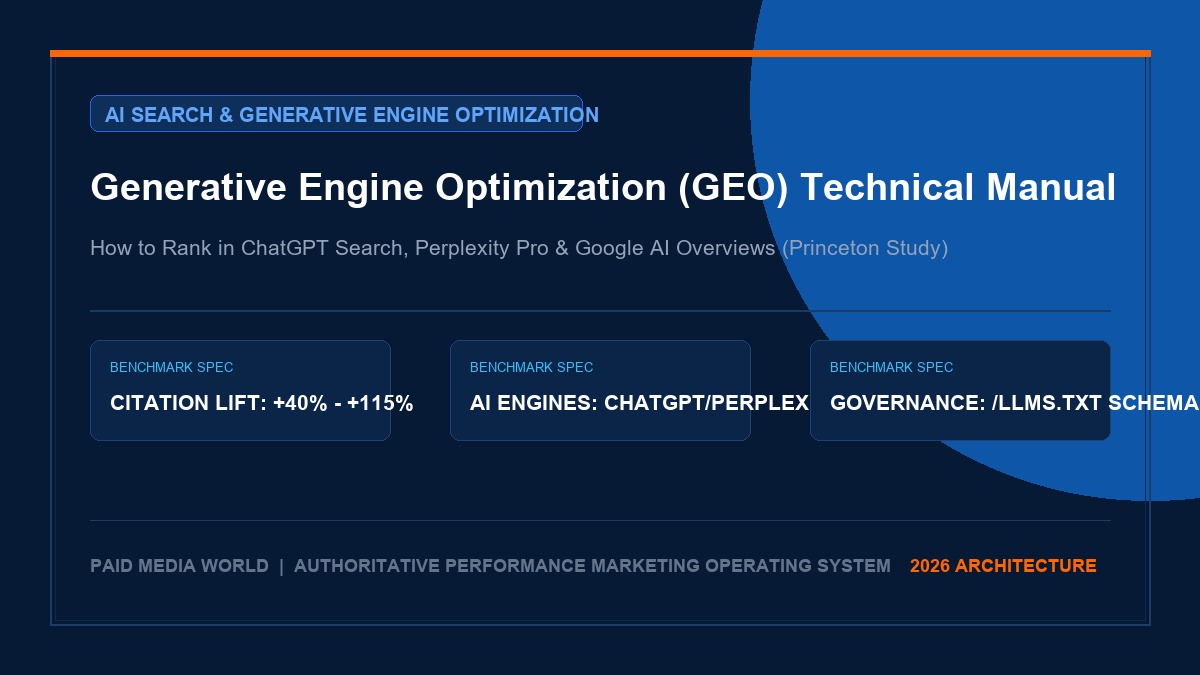
In November 2024, researchers from Princeton University, Georgia Tech, and Allen AI published the definitive peer-reviewed benchmark on Generative Engine Optimization (GEO) at ACM KDD. The researchers evaluated 10,000 queries across 9 distinct optimization techniques to measure which content modifications produce the highest citation lift in AI engines.
| Optimization Method | Citation Lift (%) | Mechanism in RAG Pipeline | Implementation Rule |
|---|---|---|---|
| 1. Statistics Addition | +37.2% | LLMs heavily bias toward quantitative precision over qualitative prose | Include verifiable percentages, dollar values, and sample sizes |
| 2. Quotation Addition | +29.8% | Named entity quotes provide verifiable authority attribution | Quote industry executives, researchers, or verified practitioners |
| 3. Cite Sources Addition | +28.4% | Source citations establish epistemic credibility in vector space | Link directly to primary studies, patents, and official docs |
| 4. Technical Terms Inclusion | +18.6% | Domain-specific jargon signals topical depth and semantic relevance | Use correct taxonomy (e.g., 'first-party cookie deprecation' vs 'cookie changes') |
| 5. Fluency Optimization | +15.1% | Grammatical clarity minimizes token perplexity scores | Eliminate passive voice, run-on clauses, and ambiguous pronouns |
| 6. Keyword Stuffing | -11.2% (Penalty) | Repetitive tokens trigger anti-spam penalties in modern embeddings | Strictly avoid unnatural repetition of exact-match terms |
4. Measuring "Share of Model" (SoM): The Successor to Share of Voice
Tracking keyword ranks #1 through #10 on a spreadsheet is no longer sufficient to measure digital reach. Your marketing operations must monitor Share of Model (SoM):
Share of Model (SoM) Formula:
SoM (%) = (Total Unprompted Brand Citations Across Target Prompt Cohort / Total Competitor Citations Across Cohort) × 100
Run 50 standardized buyer prompts across ChatGPT Search, Perplexity Pro, Google Gemini, and Claude 3.5 Sonnet weekly (e.g., "What are the top 5 performance marketing agencies for B2B SaaS in 2026?"). Record whether your brand is cited, in what position, and with what sentiment rationale.
5. Technical AEO Infrastructure: Schema Triples and Entity Graphs
Answer engines do not parse raw HTML like a human reader; they extract structured entities into a knowledge graph. To facilitate frictionless ingestion, implement three critical technical layers:
- Linked Data FAQPage Schema: Ensure every critical answer is marked up with clean
FAQPageandQuestion/AnswerJSON-LD schema referencing verified entity IDs (e.g., Wikidata, Crunchbase). - Entity Definition Triples: Structure declarative statements in Subject-Predicate-Object format (e.g., "Paid Media World [Subject] manages [Predicate] enterprise B2B Google Ads campaigns [Object]").
- llms.txt Architecture: Host a markdown file at
/llms.txtand/llms-full.txtadhering to the official LLM indexing specification, offering clean, token-efficient summaries of your core services, proprietary frameworks, and verified case studies.
6. 8-Step AEO Survival Action Checklist
Conduct a SERP Cannibalization Audit: In Google Search Console, filter for queries with high impression growth but declining CTR. Flag queries where AI Overviews occupy the top fold.
Reformat the Top 80 Words: Rewrite the introduction under every H2 to deliver an unassailable, stat-backed direct answer to the heading's target question.
Inject Quantitative Benchmarks: Add verified data tables, cost matrices, and case study percentages into every informational guide to trigger Princeton's +37.2% citation lift.
Secure Third-Party Consensus Citations: LLMs rely heavily on Reddit, YouTube transcripts, G2, Trustpilot, and authoritative industry blogs to validate claims before citing your domain.
Build Interactive Calculators & Assets: Replace basic informational articles with interactive tools, downloadable spreadsheets, and proprietary software that zero-click AI cannot replicate in the SERP.
Frequently Asked Questions (FAQ)
What is the difference between SEO and AEO?
Search Engine Optimization (SEO) focuses on ranking web pages within traditional 10 blue links search engine results pages. Answer Engine Optimization (AEO) focuses on optimizing content architecture, entity authority, and factual density so that AI assistants (Google AI Overviews, Perplexity, ChatGPT Search) synthesize and cite your brand as the primary source in conversational responses.
Can websites block Google AI Overviews without losing traditional SEO traffic?
No. Google uses the standard Googlebot crawler to generate both traditional web search results and AI Overviews. Blocking Google-Extended in robots.txt only prevents training data ingestion for Gemini models, not live retrieval within Google Search. Blocking Googlebot entirely eliminates all organic search visibility.
How can I track traffic originating from AI assistants in Google Analytics 4?
Create a Custom Channel Group in GA4 Admin using regex rules that match referral source domains including chatgpt.com|perplexity.ai|claude.ai|android-app://com.openai.chatgpt. Label this channel 'AI Referral Traffic' to distinguish it from generic web referrals.