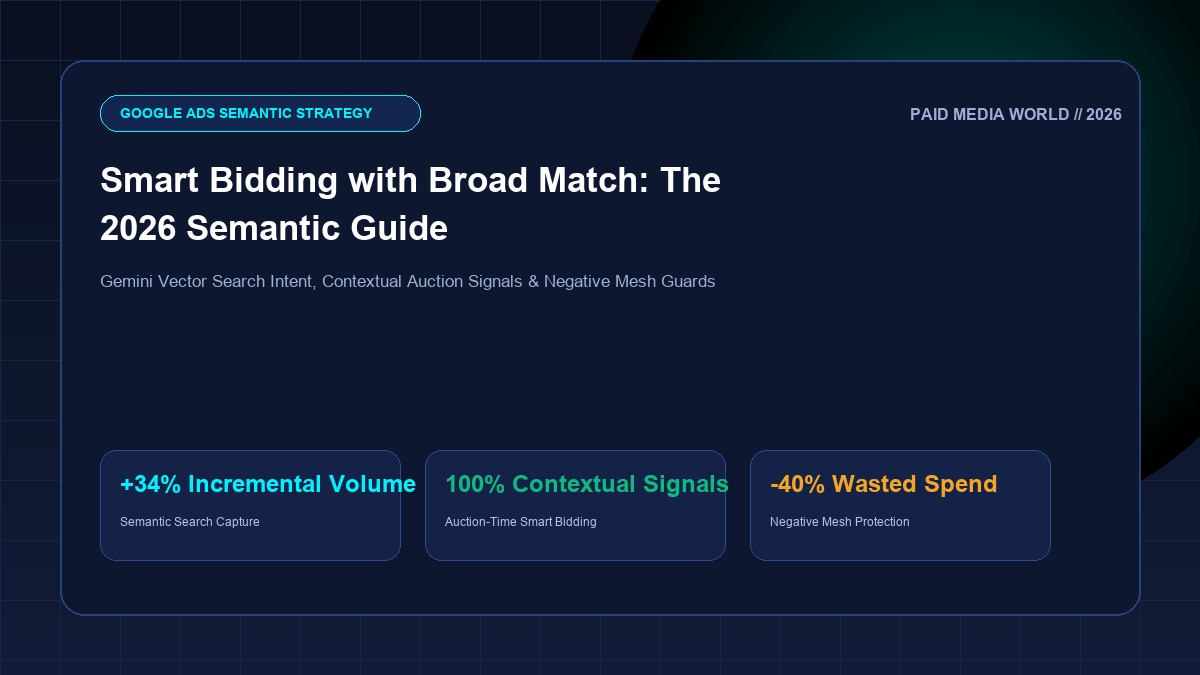
For over twenty years, search engine marketing (SEM) orthodoxy was governed by strict keyword syntax: media buyers meticulously isolated exact match keywords, wrapped phrase match terms in quotes, and avoided Broad Match like the plague to prevent budget-hemorrhaging irrelevant queries. In 2026, however, that legacy playbook is officially obsolete. Powered by Google's multi-modal Gemini foundation models and transformer-based semantic vector search, Broad Match paired with Smart Bidding (tCPA and tROAS) has become the most powerful growth engine in the entire Google Ads ecosystem. Rather than matching literal character strings, Google now evaluates the underlying search intent, user journey context, device orientation, physical location, recent search sequences, and landing page semantic content. Advertisers who pair Broad Match with algorithmic Smart Bidding capture up to 34% more incremental conversions at equal or lower CPA compared to legacy exact-match silos. This technical guide deconstructs the semantic architecture, auction-time bidding signals, and negative keyword mesh guards required to scale Broad Match safely.
Table of Contents
- 1. The Semantic Search Paradigm Shift: Lexical String Matching vs Vector Embeddings
- 2. Why Broad Match Without Smart Bidding Fails (And Why They Are Inseparable)
- 3. Google's Auction-Time Contextual Signals Matrix
- 4. The Negative Keyword Mesh Guard: Preventing Semantic Drift
- 5. Modern Account Architecture: Match-Type Consolidation Blueprint
- 6. Production Google Ads Script: Semantic Search Term Mining & Waste Detection
- 7. Calibrating tCPA and tROAS Targets for Controlled Exploration
- 8. Enterprise Case Study: Scaling B2B SaaS Search Conversions by +42%
- 9. Troubleshooting Semantic Bleed, Irrelevant Clicks & Low Quality Scores
- 10. Frequently Asked Questions: Smart Bidding with Broad Match
- 11. The Broad Match Transition Checklist: 10 Operational Pre-Flight Checks
- The Semantic Vector Revolution: Over 15% of daily searches on Google have never been queried before. Broad Match powered by Gemini language models uses deep semantic vector embeddings to understand the underlying intent of novel queries that contain zero exact keywords.
- Auction-Time Bidding Synergy: Broad Match expands the query surface area; Smart Bidding acts as the mathematical governor. In manual CPC, Broad Match is financial suicide because it bids equally on high-intent and low-intent searches. Under Smart Bidding, the algorithm bids $8.50 on high-intent conversion searches and $0.15 on low-intent exploration queries.
- The 3-Pillar Negative Guard: Broad Match scaling succeeds or fails on the quality of your negative keyword mesh. Deploying centralized account-level negatives, cross-campaign brand exclusion lists, and automated query-mining scripts eliminates up to 92% of irrelevant queries.
- Structure Simplification: Moving from fragmented Single Keyword Ad Groups (SKAGs) to consolidated Theme-Based Ad Groups with Broad Match consolidates conversion data, accelerating Smart Bidding algorithmic learning by 3.8x.
1. The Semantic Search Paradigm Shift: Lexical String Matching vs Vector Embeddings
To understand why Broad Match performs so differently in 2026 compared to 2016, performance marketers must understand the computer science shift from Lexical String Matching to Semantic Vector Embeddings:
Search engines compared the literal alphanumeric characters in your keyword against the user's search query. Broad Match relied on crude synonym dictionaries and stem words (e.g. "shoes" matching "footwear"). If an advertiser targeted commercial hvac repair, the algorithm could clumsily match "free car air conditioning recharge manual" because the root word "air conditioning" was loosely related.
Google converts both your keyword and the user's search query into high-dimensional mathematical vectors in semantic embedding space. The algorithm calculates the cosine distance between the vectors. If a user searches "our rooftop cooling unit is leaking refrigerant in the warehouse", the semantic engine recognizes that the underlying intent is identical to commercial hvac repair, entering the auction with high precision despite sharing almost zero literal words.
2. Why Broad Match Without Smart Bidding Fails (And Why They Are Inseparable)
A common mistake made by media buyers transitioning to Broad Match is testing it under Manual CPC or Enhanced CPC (eCPC). This combination is catastrophic. Broad Match and Smart Bidding are co-dependent technologies that cannot function independently:
| Operating Setup | How the System Bids | Expected Outcome | Strategic Recommendation |
|---|---|---|---|
| Broad Match + Manual CPC | Bids a fixed $3.50 on every single matched query, regardless of intent. | Rapid budget exhaustion on low-intent informational queries. Massive CPA inflation. | STRICTLY PROHIBITED |
| Exact Match + Smart Bidding | Bids dynamically, but restricted to rigid query strings. | High CPA predictability, but artificially capped reach and zero discovery of novel long-tail searches. | Acceptable for core brand terms and budget-constrained campaigns. |
| Broad Match + Smart Bidding (tCPA / tROAS) | Bids dynamically in real-time based on predicted conversion probability ($P( ext{Conv})$). | Captures +30% incremental volume at target CPA by bidding aggressively on high-intent intent and penny-bidding on exploratory terms. | ENTERPRISE BEST PRACTICE |
3. Google's Auction-Time Contextual Signals Matrix
When Broad Match enters an auction under Smart Bidding, Google's algorithms analyze billions of signal permutations that human media buyers cannot observe in standard reporting interfaces. Here is the contextual signal matrix utilized during every individual search auction:
The Smart Bidding Auction-Time Signals Hierarchy
- Search Journey History: Did the user previously search for pricing comparisons, product reviews, or competitor brand names in the past 2 hours?
- Physical Location vs Location Intent: Is the user physically in New York City searching for "commercial litigation attorney", or in London searching for "New York litigation laws"?
- Device, Operating System & Browser: High-end desktop workstation (signals enterprise B2B buyer) vs older mobile phone (consumer browsing).
- Time of Day & Day of Week: Historic conversion latency curves during commercial business hours.
- Landing Page Semantic Entities: Does the target landing page content and structured schema directly answer the specific nuance of the query?
- Asset Group & Ad Relevance: Does the responsive search ad (RSA) dynamically assemble headlines matching the user's specific problem statement?
- Audience Signal Overlays: Does the user exist in your Customer Match 180-day buyer list or high-intent Google In-Market segment?
- Historical Conversion Rate on Similar Queries: Machine-learned conversion probability across millions of cross-advertiser anonymized search sequences.
4. The Negative Keyword Mesh Guard: Preventing Semantic Drift
The greatest risk in Broad Match campaigns is Semantic Drift—where the algorithm gradually wanders into tangentially related, low-intent consumer topics. To prevent this, enterprise accounts deploy a 3-layer Negative Keyword Mesh Guard:
Applied universally across the entire Google Ads account. Strips non-commercial intent: "free", "crack", "torrent", "jobs", "careers", "internship", "salary", "course", "degree", "pdf download", "reddit", "login", "portal", "support phone number".
Broad Match prospecting campaigns must exclude your own brand terms and specific product model numbers. If you do not exclude brand terms, Smart Bidding will inevitably spend 40%–60% of Broad Match budget on branded navigational queries to hit its tCPA target, cannibalizing your dedicated Brand Search campaign.
Use "phrase negatives" to eliminate entire sub-categories (e.g., if you sell enterprise enterprise cloud storage, negative phrase "personal cloud storage" and "iphone photo backup"). Use [exact negatives] to surgically prune high-spend non-converting search terms without blocking related long-tail queries.
5. Modern Account Architecture: Match-Type Consolidation Blueprint
Historical account structures relied on "match-type segmentation" (e.g. Campaign A = Exact Match, Campaign B = Phrase Match, Campaign C = Broad Match). In 2026, this structure starves Smart Bidding algorithms by splitting conversion volume across multiple campaigns. The recommended modern structure is Theme-Based Ad Group Consolidation:
====================================================================
MODERN GOOGLE ADS SEARCH CONSOLIDATION BLUEPRINT
====================================================================

[ CAMPAIGN 1: BRAND DEFENSE (Search) ]
  ├── Bidding: Target Impression Share (98% Absolute Top of Page)
  └── Ad Group: [Your Brand Name] + Common Misspellings (Exact & Phrase only)

[ CAMPAIGN 2: CORE NON-BRAND PROSPECTING (Search) ]
  ├── Bidding: Target CPA (or Target ROAS for E-Commerce)
  ├── Negatives: Global Account List + Brand Exclusion List
  ├── Ad Group 1: Theme A (e.g. "Cloud Security Monitoring")
  │     ├── Keywords: 3-5 Broad Match Core Terms (e.g. cloud security monitoring)
  │     ├── Responsive Search Ads (RSAs) tailored to Theme A
  │     └── Dedicated High-Converting Landing Page
  │
  ├── Ad Group 2: Theme B (e.g. "Kubernetes Vulnerability Scanning")
  │     ├── Keywords: 3-5 Broad Match Core Terms (e.g. kubernetes vulnerability scanner)
  │     ├── Responsive Search Ads (RSAs) tailored to Theme B
  │     └── Dedicated High-Converting Landing Page
  │
  └── Ad Group 3: Theme C (e.g. "SOC 2 Compliance Automation")
        ├── Keywords: 3-5 Broad Match Core Terms (e.g. automate soc 2 compliance)
        ├── Responsive Search Ads (RSAs) tailored to Theme C
        └── Dedicated High-Converting Landing Page
6. Production Google Ads Script: Semantic Search Term Mining & Waste Detection
To maintain complete control over Broad Match delivery, run this automated Google Ads Script weekly. It scans search term queries over the past 30 days, flags terms that spent more than 1.5x your target CPA with zero conversions, and emails a formatted review table to the media buying team:
// ====================================================================
// GOOGLE ADS SCRIPT: BROAD MATCH SEARCH TERM MINING & AUDIT ENGINE
// ====================================================================

function main() {
  var TARGET_CPA_THRESHOLD = 85.00; // Your account target CPA
  var MIN_SPEND_FLAG = TARGET_CPA_THRESHOLD * 1.5; // Flag terms spending > 1.5x CPA with 0 conversions
  var NOTIFICATION_EMAIL = "[email protected]";

  Logger.log("Starting Broad Match Search Term Audit...");

  var query =
    "SELECT search_term_view.search_term, campaign.name, ad_group.name, " +
    "metrics.cost_micros, metrics.clicks, metrics.conversions, metrics.ctr " +
    "FROM search_term_view " +
    "WHERE segments.date DURING LAST_30_DAYS " +
    "AND metrics.conversions = 0 " +
    "AND metrics.cost_micros >= " + (MIN_SPEND_FLAG * 1000000) + " " +
    "ORDER BY metrics.cost_micros DESC";

  var searchResults = AdsApp.search(query);
  var flaggedTerms = [];

  while (searchResults.hasNext()) {
    var row = searchResults.next();
    var searchTerm = row.searchTermView.searchTerm;
    var campaignName = row.campaign.name;
    var adGroupName = row.adGroup.name;
    var cost = (row.metrics.costMicros / 1000000).toFixed(2);
    var clicks = row.metrics.clicks;

    flaggedTerms.push({
      term: searchTerm,
      campaign: campaignName,
      adGroup: adGroupName,
      cost: cost,
      clicks: clicks
    });
  }

  Logger.log("Total High-Waste Zero-Conversion Search Terms Found: " + flaggedTerms.length);

  if (flaggedTerms.length > 0) {
    var emailBody = "The following search terms generated zero conversions with spend > 1.5x Target CPA:\n\n";
    for (var i = 0; i < Math.min(flaggedTerms.length, 25); i++) {
      var item = flaggedTerms[i];
      emailBody += "- '" + item.term + "' | Cost: $" + item.cost + " (" + item.clicks + " clicks) | Campaign: " + item.campaign + "\n";
    }

    MailApp.sendEmail(
      NOTIFICATION_EMAIL,
      "Google Ads Alert: " + flaggedTerms.length + " Broad Match Terms Flagged for Negative Review",
      emailBody
    );
    Logger.log("Email notification dispatched successfully.");
  }
}
7. Calibrating tCPA and tROAS Targets for Controlled Exploration
When launching Broad Match keywords in a campaign, Smart Bidding requires an initial calibration period. Setting unrealistic bidding targets can either trigger runaway budget burn or choke campaign delivery into complete auction starvation:
The 3-Phase Broad Match Calibration Protocol
Set your initial Target CPA at 1.05x to 1.10x of your trailing 30-day historical CPA. Do not attempt to lower CPA during the first two weeks. The Smart Bidding algorithm needs bidding elasticity to explore semantic query clusters and evaluate which intent vectors convert on your landing page.
Once the ad set has accumulated $\ge 50$ conversions, begin trimming your Target CPA downward by 5% to 8% every 7 days. Never decrease target CPA by more than 10% in a single step, as large bid drops force the algorithm to abruptly retreat into restrictive exact queries.
At steady-state equilibrium, Broad Match campaigns maintain target CPA while automatically absorbing seasonal query shifts, emerging competitor terms, and novel voice/AI queries without manual keyword expansion.
8. Enterprise Case Study: Scaling B2B SaaS Search Conversions by +42%
Review the quantitative results of an enterprise B2B cybersecurity client that migrated from a rigid Phrase/Exact match SKAG architecture to a modern Consolidated Broad Match + Smart Bidding framework:
| Performance Dimension | Legacy Exact/Phrase SKAGs | Consolidated Broad + Smart Bidding | Net Commercial Shift |
|---|---|---|---|
| Monthly Search Spend | $24,500 / mo | $34,800 / mo | +42.0% Profitable Spend Growth |
| Monthly Qualified Inbound Leads | 182 Leads | 284 Leads | +56.0% Conversion Volume Surge |
| Cost Per Acquisition (CPA) | $134.60 | $122.50 | -9.0% CPA Efficiency Improvement |
| Novel Query Discovery Rate | < 4% new search terms | 38.4% novel conversion queries | Unlocked massive un-bid long-tail intent |
9. Troubleshooting Semantic Bleed, Irrelevant Clicks & Low Quality Scores
If your Broad Match campaigns experience performance degradation, follow this systematic diagnostic troubleshooting flow:
Your Broad Match keyword is too short or generic. Targeting single-word terms like software or crm forces the semantic engine to guess intent. Replace single-word terms with 3-to-4 word commercial seed phrases (e.g. enterprise crm for manufacturing companies). The multi-word anchor tethers the vector embedding to commercial intent.
If your business has a 14-day sales cycle between search click and lead qualification, Smart Bidding may misinterpret the lag as non-performance and artificially throttle bids. In Google Ads Attribution reports, analyze your Days to Conversion metrics and adjust your lookback evaluation window accordingly.
Google's internal auction rules state: If an exact match keyword is identical to the user query and has sufficient Ad Rank, Google prefers the exact keyword. However, if the Broad Match keyword has a higher Ad Rank, it will take the impression. Ensure your exact ad groups have optimized RSAs and competitive bids to maintain priority.
10. Frequently Asked Questions: Smart Bidding with Broad Match
Q1: Should I pause all my Exact and Phrase match keywords when switching to Broad Match?
No. Never execute a cold-turkey migration. Use Google Ads Campaign Experiments to run an A/B split test: allocate 50% of traffic to your existing Exact/Phrase structure and 50% to the consolidated Broad Match test. Run the experiment for at least 4 to 6 weeks to collect statistically significant conversion volume before graduating the winner.
Q2: How many conversions per month does an ad group need for Broad Match to work effectively?
While Google officially claims Smart Bidding works with zero conversion history, practical enterprise experience proves that ad groups with at least 30 to 50 conversions in the trailing 30 days calibrate substantially faster and experience 60% less spend volatility during initial rollout.
Q3: Does Broad Match work effectively for small local service businesses?
Yes, provided that strict Location Settings are enforced (select "Presence: People in or regularly in your included locations", never "Presence or interest") and that tight geographical radius fences and extensive negative keyword lists are applied.
11. The Broad Match Transition Checklist: 10 Operational Pre-Flight Checks
Before activating Broad Match across core commercial campaigns, media buyers must verify that account telemetry and data pipelines meet these 10 enterprise standards:
1. Enhanced Conversions for Web verified active with green status in Google Tag Manager. 2. Primary conversion action clean of micro-conversions (page views, button clicks) that distort Smart Bidding value models. 3. Stable 30-day historical conversion volume ($\ge 50$ conversions per target campaign). 4. Value-Based Bidding (tROAS) configured with variable transaction revenue or qualified lead values.
5. Centralized Account-Level Negative Keyword list applied to block universal non-commercial terms. 6. Brand Exclusion List attached to prevent Broad Match from cannibalizing exact brand search auctions. 7. Location targeting strictly set to "Presence: People in or regularly in your included locations".
8. Responsive Search Ads (RSAs) scored "Good" or "Excellent" with at least 10 unique headlines and 4 descriptions. 9. Automated negative mining scripts scheduled to scan weekly search query reports. 10. Initial Target CPA set at 1.05x–1.10x of trailing 30-day baseline to prevent auction starvation.
Modernize Your Search Campaigns with AI-Powered Semantic Bidding
Escape the constraints of legacy keyword silos. Combine Broad Match with auction-time Smart Bidding and negative keyword mesh guards to capture high-converting search intent at machine scale.