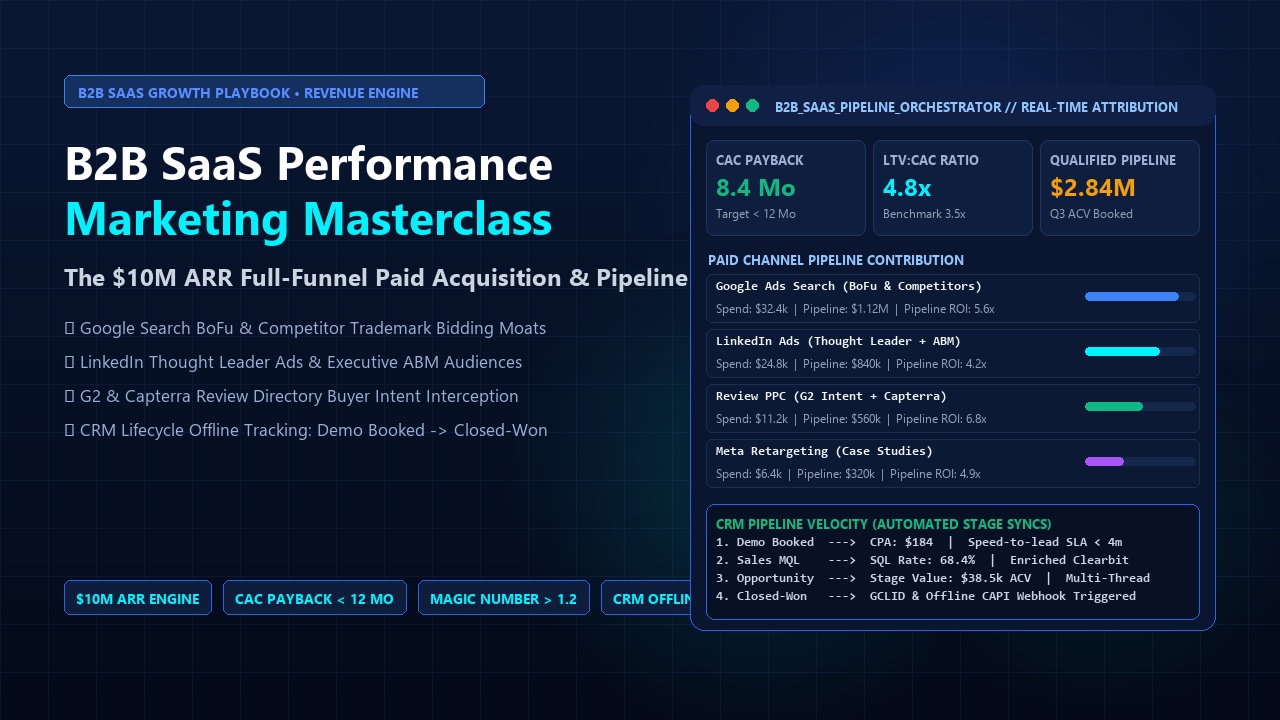
Scaling a modern software company from initial product-market fit ($1M ARR) to venture-scale enterprise traction ($10M+ ARR) requires a completely different paid media operating system than consumer eCommerce. In enterprise software, transactions do not happen in a 15-minute browser session.
Buying cycles span 60 to 180 days, Annual Contract Values (ACV) range from $12,000 to $150,000+, and buying committees comprise 6 to 10 cross-functional stakeholders.
Executing high-growth B2B SaaS performance marketing is not about chasing cheap cost-per-click (CPC) or unvetted "free trial" form fills—it is about orchestrating an unyielding full-funnel paid acquisition engine engineered directly for pipeline velocity, sales-qualified opportunities (SQLs), and capital-efficient net new ARR.
- Unit Economics Guardrails: Blended CAC Payback Period ≤ 12 months for Mid-Market and ≤ 18 months for Enterprise ACV; LTV:CAC Ratio ≥ 3.5:1; SaaS Magic Number ≥ 1.0 to 1.4.
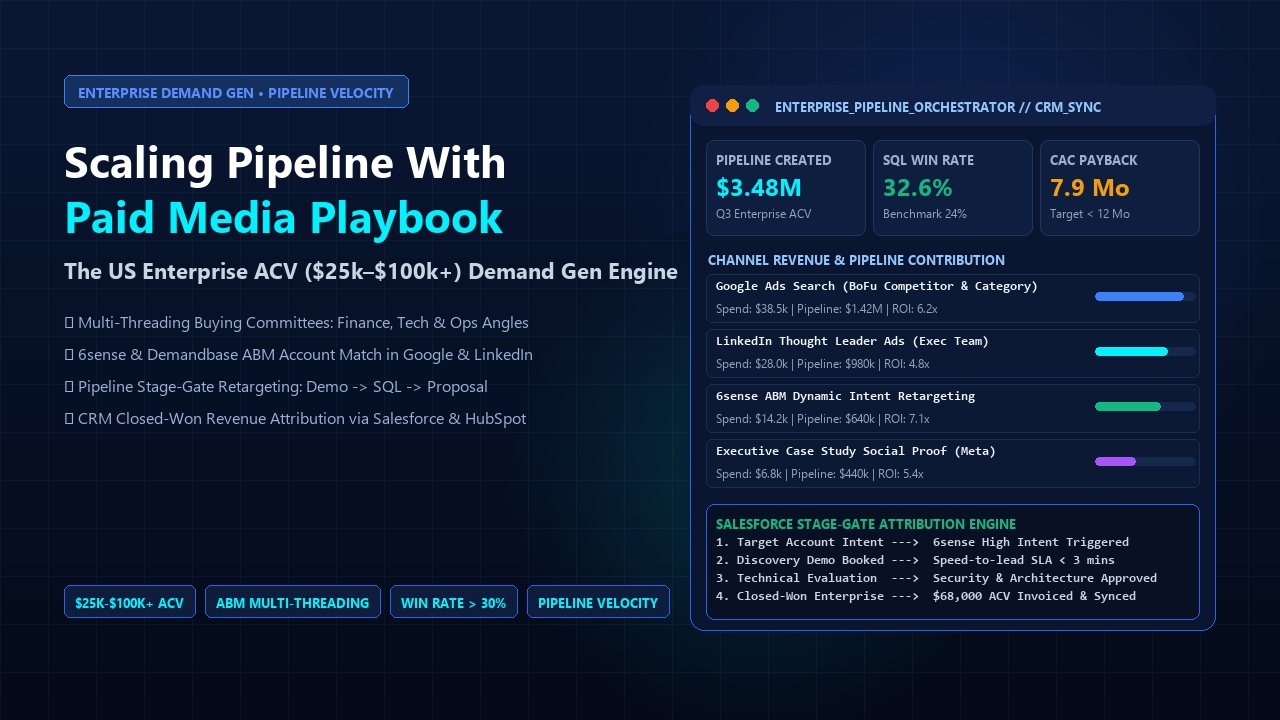
- Channel Architecture: The high-performing B2B Triad pairs Google Ads Search (BoFu high-intent category & competitor terms), LinkedIn Thought Leader & Document Ads (MoFu ICP committee nurturing), and Software Review Directories (G2, Capterra) for real-time buyer intent capture.
- Competitor Trademark Bidding & Affiliates: Capitalizing on high-intent competitor displacement searches while adhering strictly to Google Ads Trademark Policies; managing SaaS affiliate programs allowing brand bidding with negative keyword meshes to avoid direct cannibalization.
- Pipeline-First Measurement: Eradicate front-end lead gen optimization. Implement offline conversions tracking for SaaS via Google Ads Enhanced Conversions for Leads and Meta Conversions API (CAPI) tied directly to CRM lifecycle milestones (
Demo Completed → SQL → Pipeline Opportunity → Closed-Won).
Table of Contents
- 1. The Financial Architecture of B2B SaaS Performance Marketing
- 2. The Triad Channel Matrix: Google Search, LinkedIn Ads & Meta Retargeting
- 3. Competitor Trademark Bidding & SaaS Affiliate Brand Bidding Moats
- 4. Software Directory PPC: Dominating G2, Capterra & Buyer Intent Signals
- 5. Offline Conversion Tracking for SaaS: Syncing CRM Stages to Ad Algorithms
- 6. B2B SaaS Budget Scaling Playbook: From $10k/mo to $250k/mo Spend
- 7. Frequently Asked Questions (B2B SaaS Performance Marketing FAQ)
1. The Financial Architecture of B2B SaaS Performance Marketing
The most catastrophic error performance agencies make when entering B2B SaaS is treating advertising spend as an operational marketing expense aimed at achieving an immediate 3x–5x Return on Ad Spend (ROAS).
In subscription SaaS, customers pay on monthly or annual renewal cycles with gross margins typically hovering between 75% and 85%. Because revenue compounds over a 3- to 7-year Customer Lifetime (LTV), judging paid media on Day-1 cash return guarantees under-investment and stunts ARR trajectory.
World-class B2B growth leaders calibrate their paid acquisition budget against four non-negotiable financial unit economics:
CAC Payback Period
CAC Payback = Fully Loaded CAC / (Monthly ARPU × Gross Margin %)
Target: ≤ 12 months for SMB/Mid-Market; ≤ 18 months for Enterprise deals with negative net churn.
LTV to CAC Ratio
LTV:CAC = (Annual ARPU × Gross Margin % / Churn Rate) / Fully Loaded CAC
Target: 3.5x to 5.0x. An LTV:CAC above 6.0x indicates under-investment in paid acquisition scale.
SaaS Magic Number
Magic Number = (Q(N) Revenue - Q(N-1) Revenue) × 4 / Q(N-1) S&M Expense
Target: > 1.0 (efficient acquisition engine); 0.75–1.0 (sustainable growth); < 0.75 (inefficient funnel leak).
Pipeline Velocity
Velocity = (Qualified Opps × Win Rate % × Average Deal Size) / Sales Cycle Days
Paid media must be engineered to accelerate deal velocity by educating buying committees prior to sales demo calls.
2. The Triad Channel Matrix: Google Search, LinkedIn Ads & Meta Retargeting
Relying on a single acquisition network is the fastest way to hit an ARR growth plateau. High-growth B2B SaaS engines deploy a coordinated Triad architecture where each channel executes a specific role in the buyer journey:
| Paid Channel | Funnel Stage & Objective | Primary Ad Formats | Benchmark CPL / SQL | Target Conversion KPI |
|---|---|---|---|---|
| Google Ads Search | BoFu Intent Capture Intercepting users actively looking to buy or replace software. |
Exact Match RSA, Dynamic Search Ads (DSA) for documentation, Sitelink Extensions. | Demo CPL: $110 – $240 SQL: $350 – $750 |
Demo Booked Rate > 8% |
| LinkedIn Ads | MoFu ICP Committee Nurturing Targeting specific Job Functions, Seniorities, and Company Size tiers. |
Thought Leader Ads (founder/VP posts), Document Ads (ungated PDF slides), Single Image. | MQL: $65 – $140 SQL: $450 – $950 |
Account Engagement > 35% |
| Software Directories (G2 / Capterra) | Active Evaluation & Comparison Bypassing standard SERP competition during active vendor evaluations. |
Category Top 3 Sponsored Slots, G2 Buyer Intent Audiences pushed to Google Ads. | Trial / Demo CPL: $85 – $180 SQL: $280 – $600 |
Win Rate > 28% |
| Meta Ads (Retargeting) | Social Proof & Objections Removal Surrounding decision-makers while they consume social feeds on mobile. |
Customer Video Testimonials, Product UI Micro-demos, Interactive ROI Calculators. | Retargeting CPL: $45 – $95 Demo SQL: $220 – $480 |
Pipeline Re-activation > 18% |
Why LinkedIn Thought Leader Ads Outperform Traditional Sponsored Content by 3.2x
In 2026, enterprise software buyers tune out faceless company logos promoting generic whitepapers. LinkedIn Thought Leader Ads permit brands to boost organic posts published by executives, product managers, or engineering leads. When an engineering VP discusses real architectural challenges solved by your software, the Click-Through Rate (CTR) typically averages 1.8%–3.1% (compared to 0.45% on traditional sponsored content), and Cost Per Qualified Lead drops by up to 52%.
3. Competitor Trademark Bidding & SaaS Affiliate Brand Bidding Moats
Competitor search terms represent the highest-intent commercial search traffic on Google. When a prospect searches "[Competitor] pricing", "alternative to [Competitor]", or "[Competitor] vs [Our Brand]", they have already completed their problem-identification phase and are in the final vendor procurement cycle.
Google Ads Trademark Policy Rules for B2B Marketers
Under Google Ads Trademark Policy, you are 100% legally permitted to bid on competitor brand trademarks as keywords in all major jurisdictions (US, EU, UK, India, Canada). However, you cannot use the trademarked competitor name in your ad headline or description text unless your landing page offers genuine competitive analysis, spare parts, or reseller services.
To maximize Quality Score without policy violations, use headlines like: "Evaluating Alternatives? | Transparent Pricing & Faster Setup" and reserve the competitor name for the display path URL (e.g., paidmediaworld.com/compare/competitor).
Managing SaaS Affiliate Programs Allowing Brand Bidding
A major pain point for B2B SaaS growth marketing is managing affiliate and partner programs. When a SaaS affiliate program allows brand bidding and direct linking, aggressive affiliates bid on your primary brand name ("[Brand] discount code", "[Brand] coupon", "[Brand] login"). This directly drives up your brand CPCs in Google Ads auctions and cannibalizes organic search clicks you would have earned for free.
The Strict Affiliate Brand Bidding Moat Protocol:
- Negative Keyword Exclusion List: Provide all affiliate networks (Impact, PartnerStack, ShareASale) with an exhaustive negative keyword list containing your brand name, core product names, executive names, and common misspellings.
- Direct Linking Prohibition: Forbid affiliates from using your root domain as the display URL. Require affiliates to drive traffic to their own comparison landing pages or software review roundups.
- Allowed Competitor Bidding Tiers: Permit select high-tier affiliates to bid on competitor keywords (e.g.,
"alternative to [competitor]") if your internal media buying team does not actively contest those specific long-tail software categories.
4. Software Directory PPC: Dominating G2, Capterra & Buyer Intent Signals
According to industry research, over 80% of B2B enterprise software purchases consult third-party review aggregators prior to executing a contract. Partnering with a specialized Capterra ads agency or managing review directory PPC internally unlocks access to in-market buyers with immediate budget authorization.
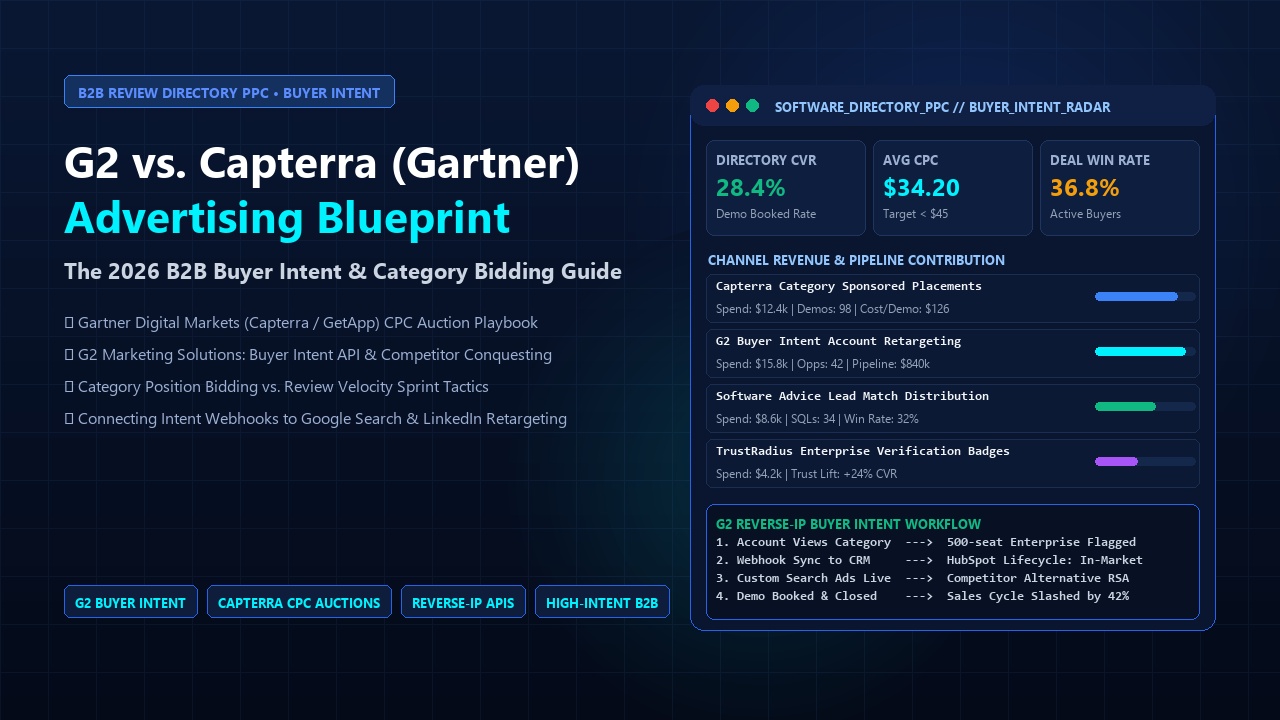
Gartner Digital Markets (Capterra, Software Advice, GetApp) vs. G2 Marketing Solutions
Capterra (Gartner Digital Markets)
Operates on a pure Pay-Per-Click (CPC) auction model. Advertisers bid for top 4 category placement. Clicks convert directly to website landing pages. Excellent for SMB and Mid-Market software with self-serve free trials or transparent entry pricing ($20–$65 average CPC).
G2 Marketing Solutions
Operates on an Annual Subscription + Buyer Intent Data model. Premium vendors get customized profiles, competitor page banner takeovers, and direct API access to intent data streams identifying which corporate accounts are researching your category.
The G2 Buyer Intent Reverse-IP Activation Stack
The most sophisticated play in B2B SaaS performance marketing is synchronizing G2 Buyer Intent data directly with your paid media channels:
- When an account (e.g., a 500-person enterprise) views your category or your competitor's profile on G2, G2 logs the reverse-IP company identity.
- G2 pushes this account list via webhook to your CRM (HubSpot/Salesforce) and ad platforms (LinkedIn Matched Audiences & Google Ads Customer Match).
- Within 2 hours, decision-makers at that specific enterprise start seeing highly relevant LinkedIn Thought Leader Ads and custom Google Search ads featuring customer case studies in their exact industry.
5. Offline Conversion Tracking for SaaS: Syncing CRM Stages to Ad Algorithms
If your Google Ads campaigns or Meta ad sets are bidding on a standard "Thank You Page" form submission or simple "Demo Requested" event, Google's Smart Bidding and Meta's Advantage+ algorithms will systematically optimize for whatever audience fills out forms the cheapest. This floods your sales development representatives (SDRs) with students, competitors, retired consultants, and unqualified leads.
To unlock capital-efficient enterprise growth, implement offline conversions tracking for SaaS. By feeding real down-funnel deal values back into ad platform algorithms, you train machine learning models to hunt exclusively for accounts that convert to closed-won revenue:
Whenever your sales team moves an opportunity stage in HubSpot or Salesforce, an automated webhook fires Google's ConversionUploadService and Meta's Conversions API, transmitting the original GCLID or hashed email along with the actual dollar value. Over 4 to 8 weeks, algorithmic Target CPA and Value-Based Bidding (tROAS) shift ad delivery away from low-intent searchers and straight toward high-value corporate decision-makers.
6. B2B SaaS Budget Scaling Playbook: From $10k/mo to $250k/mo Spend
Scaling paid acquisition requires distinct tactical playbooks at each ARR milestone:
Phase 1: Seed to $3M ARR ($10,000 – $35,000 / month)
Budget Allocation: 70% Google Ads Search (Exact match software category terms + core competitors), 20% Capterra/G2 Category Sponsored Listings, 10% Meta Website Retargeting.
Focus: Finding your single repeatable high-intent conversion loop and validating that paid demos close at ≥ 18% into paying customers.
Phase 2: Growth to $10M ARR ($35,000 – $100,000 / month)
Budget Allocation: 45% Google Ads (Broad Match with Smart Bidding + Competitor Conquesting), 30% LinkedIn Ads (Thought Leader Ads + Document Ads targeting buying committee), 15% G2 Buyer Intent Audiences, 10% Multi-Touch Retargeting.
Focus: Full integration of CRM offline conversion tracking, Account-Based Marketing (ABM) list targeting, and speed-to-lead automation (< 5 minute response SLA).
Phase 3: Scale to $25M+ ARR ($100,000 – $250,000+ / month)
Budget Allocation: 35% Google Ads (Demand Gen + Global Search expansion), 30% LinkedIn ABM & Executive Sponsorship, 15% YouTube Shorts & In-Stream Video Problem-Agitation, 10% Software Directories, 10% Programmatic Display / CTV.
Focus: Category creation, brand defensibility, international multi-currency campaigns, and advanced Media Mix Modeling (MMM) calibration.
50 Marketing Calculators Hub
Calculate Break-Even ROAS, Target CPA, Blended MER, and CAC Payback periods with our deterministic growth engineering tools.
7. Frequently Asked Questions (B2B SaaS Performance Marketing FAQ)
What is a good Customer Acquisition Cost (CAC) for B2B SaaS?
A healthy B2B SaaS CAC is defined by the CAC Payback Period rather than a flat dollar amount. For SMB software (ACV < $5,000), target a payback period under 6 to 9 months. For Mid-Market software (ACV $10,000 to $50,000), target under 12 months. For Enterprise SaaS (ACV $50,000+), payback up to 15–18 months is acceptable provided net revenue retention (NRR) exceeds 115%.
Should B2B SaaS companies offer a Free Trial or Book a Demo on paid landing pages?
If your product has low implementation friction, quick time-to-value, and an ACV below $5,000/year, a self-serve Free Trial (Product-Led Growth) converts with lower friction. If your product requires complex data integrations, enterprise security approvals, and has an ACV exceeding $15,000, driving paid media to a personalized Interactive Product Tour or Book a Demo funnel generates significantly higher pipeline value.
How does competitor trademark bidding work without getting sued?
In Google Ads, you can bid on any competitor trademark as a keyword. However, to comply with trademark regulations, never include the competitor trademark in your ad headline, copy, or make false claims. Ensure your landing page provides a factual, objective comparison matrix or highlights distinct differentiators without deceptive branding.
Why is my LinkedIn Ads Cost Per Lead (CPL) so much higher than Meta?
LinkedIn charges a premium ($8 to $22+ CPC) because of unmatched deterministic B2B targeting (exact job titles, company size, industry, seniority). While LinkedIn CPL is often 2x–4x higher than Meta, LinkedIn leads routinely convert to SQLs and closed deals at a 3x higher rate, resulting in a significantly lower Cost Per Closed-Won Deal.
B2B SaaS Performance Marketing Architecture: Capturing High-Intent Demand
Scaling B2B SaaS performance marketing requires moving beyond surface-level lead generation to pipeline generation measured strictly by Customer Acquisition Cost (CAC) payback periods and Pipeline-to-Spend ratios. When enterprise software buyers evaluate software solutions, their journey spans high-intent Google Search queries, peer review directories like G2 and Capterra, and retargeting touchpoints across LinkedIn and Meta.
1. High-Intent Search Alpha
Bidding strictly on exact-match commercial intent queries like "enterprise CRM software" and competitor alternatives.
2. Review Site Synergy
Sponsoring top category placements on G2 and Capterra to intercept in-market buyers comparing product features.
3. First-Party Retargeting
Re-engaging demo visitors via Meta Conversions API and LinkedIn Account-Based Marketing (ABM) matched lists.
Explore our complete breakdown of full-funnel performance marketing strategy to align your paid channels with sales pipeline milestones.